
Between Black Friday, 12.12 sales, Christmas shopping and year-end holidays, an inbox full of limited-time offers and parcel notifications hardly warrants a second look. Unfortunately, a fraudulent delivery notification or time-sensitive deal fits right in.
While police-reported scam cases fell 14.4 per cent in the first half of 2026, the Financial Industry Disputes Resolution Centre (FIDReC) received a record 5,344 claims in its latest financial year. Fraud and scam claims handled rose 18 per cent to 1,515, accounting for 45 per cent of all cases it handled.
What’s more revealing is how scammers get their hands on the money in the first place. According to the Singapore Police Force (SPF), 80.8 per cent of reported scam cases in the first half of 2026 involved victims transferring money themselves. In most cases, scammers didn’t need to break into a bank account — they just needed to make a convincing pitch.
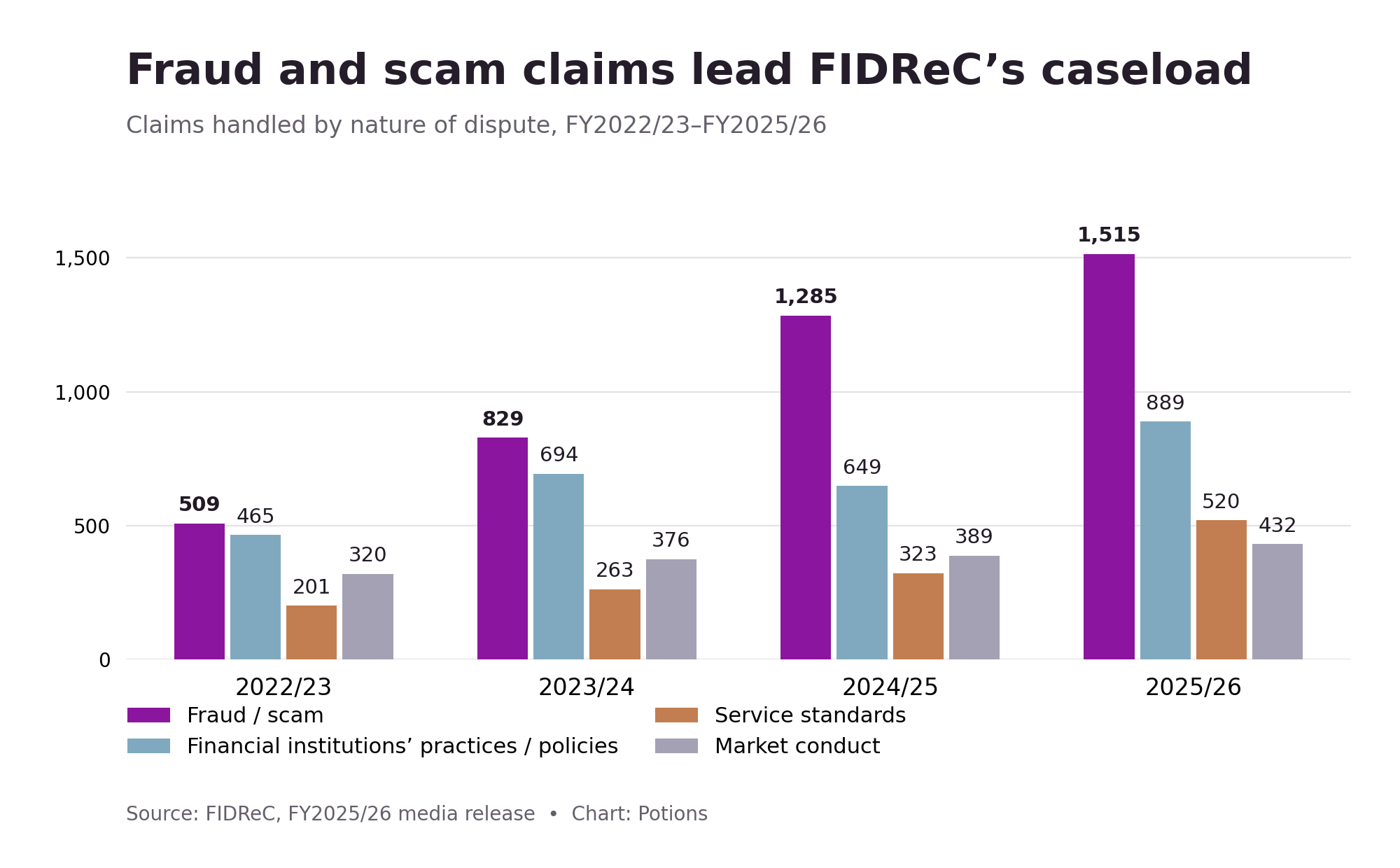
Fraud and scam claims have nearly tripled since FY2022/23. FIDReC FY2025/26 media release; chart redrawn by Potions
Nobody is immune
If your mental image of a scam victim is an elderly person losing their life savings, consider this: 64.4 per cent of reported scam victims in Singapore in the first half of 2026 were under 50. Half of all reported scam cases involved losses of SGD 1,350 or less.
Different age groups tend to fall for different scams. Shopping scams are more common among younger victims, while investment and government impersonation scams feature more prominently among older victims, who also suffer higher average losses.
Marketing or scam? It’s the same psychology
Limited editions, celebrity endorsements, glowing testimonials and free samples. If you’ve ever bought something you hadn’t originally intended to, you’ll probably recognise some of these.
Singapore’s ScamShield identifies six principles of persuasion, drawing on the work of psychologist Robert Cialdini. They’re familiar tools of the marketing trade, but equally useful to scammers.
What makes them particularly insidious in the context of scams is that we encounter them routinely in perfectly legitimate transactions.
Throw fear, excitement or time pressure into the mix, and thinking critically becomes that much harder.



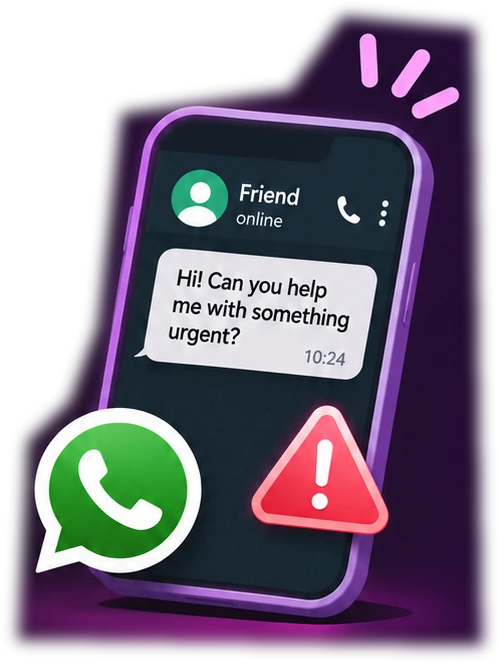

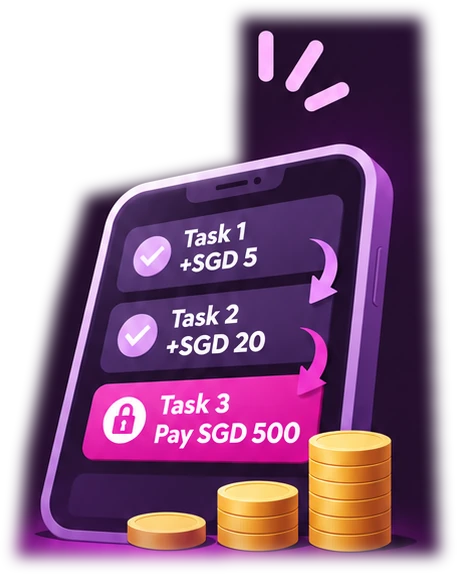
A note on the figures: The statistics illustrate documented scam tactics, not the effectiveness of individual persuasion techniques. The psychological framework draws on the work of Robert Cialdini and ScamShield’s guidance. Statistical sources are credited on each card. Illustrations developed with AI.
Build your defences before you need them
Scammers can reinforce these persuasion techniques with fear, urgency and isolation.
In an anonymised case study published by FIDReC, a 74-year-old woman lost about SGD 1.2 million to bank and government impersonators. Even when her bank questioned the unusual transfers, she repeated a cover story the scammers supplied.
‘Be careful’ is well-meaning but not particularly useful advice when you don’t know what to look out for. A better way is to put safeguards in place that don’t rely entirely on your judgement in the heat of the moment.

Shopping on a smartphone. Leeloo The First / Pexels
- Passkeys: Replace passwords where supported with phishing-resistant logins that won’t work on imitation websites.
- Money Lock: Keep savings you don’t need immediate access to out of reach of digital withdrawals and transfers.
- Transaction limits and alerts: Limit potential losses and spot unusual activity early.
- Bank app call verification: Where supported, check whether an incoming call genuinely originates from your bank.
- Protected marketplace payments: Use the platform’s protected payment system rather than paying sellers directly.
- ScamShield: Block suspected scam calls, filter or flag suspicious SMSes, depending on your device, and check messages, numbers and links.
Each addresses a different vulnerability. A passkey can protect your login, but it cannot stop you from authorising a fraudulent payment. By layering them, you reduce — not remove — the risk of a single lapse resulting in significant losses.
What if you’ve already been scammed?
If you’ve transferred money or disclosed banking credentials to a scammer, stop communicating with them, contact your bank immediately and activate its emergency kill switch if necessary. Preserve messages and transaction records, and file a police report.
If you’re still at the stage of wondering whether something is a scam, call the 24-hour ScamShield helpline at 1799. Around 84 per cent of calls received were enquiries checking whether something was a scam. You don’t need to be a victim to ask for help.
Now the reality check: getting your money back is considerably harder. While the SPF reported recovering more than SGD 97.7 million in scam losses in the first half of 2026, it refers to funds frozen, not money returned to victims.
Frozen funds are monies that have been blocked from further transfer or withdrawal, but have not necessarily been cleared for return to their rightful owners. The process is subject to ownership verification and the completion of investigations and relevant court proceedings. Recovery is not guaranteed, and there is no fixed timeline. Also be wary of anyone promising to recover your stolen money for an upfront fee — scam victims can become targets all over again.
Even if the stolen money cannot be recovered, compensation may still be possible. Singapore’s Shared Responsibility Framework covers qualifying phishing scams where banks or telecommunications providers fail to fulfil specified duties, but excludes payments that victims were deceived into authorising themselves.
When responsibility for the loss remains in dispute, that’s where FIDReC comes in. Of the 1,523 fraud and scam claims it completed in FY2025/26:
- 63 per cent resulted in settlements at mediation.
- 88 per cent were completed within six months, excluding the interval between mediation and adjudication.
- Only 19 of the 148 claims that proceeded to adjudication (a formal ruling) resulted in consumer awards.
Mediation is not a silver bullet. But it can provide an avenue for compensation even when a victim has a weak legal case.
In FIDReC’s earlier impersonation scam example, the woman was assessed to have little chance of succeeding at adjudication because she had authorised the transfers herself. Through mediation, however, she secured a goodwill settlement covering 10 per cent of her losses. It shows how mediation can offer some financial relief even when the chances of holding the bank responsible are slim.
No matter how sophisticated our technological safeguards become, it cannot make us immune to persuasion — scammers always have, and will continue to, exploit the human element.
And while avenues for redress exist, even a favourable outcome may leave victims substantially out of pocket. Understanding how we are being manipulated is arguably one of our best lines of defence.
Scammers don’t always need to sell you an elaborate lie. Sometimes, they only need to make an extraordinary request feel ordinary.