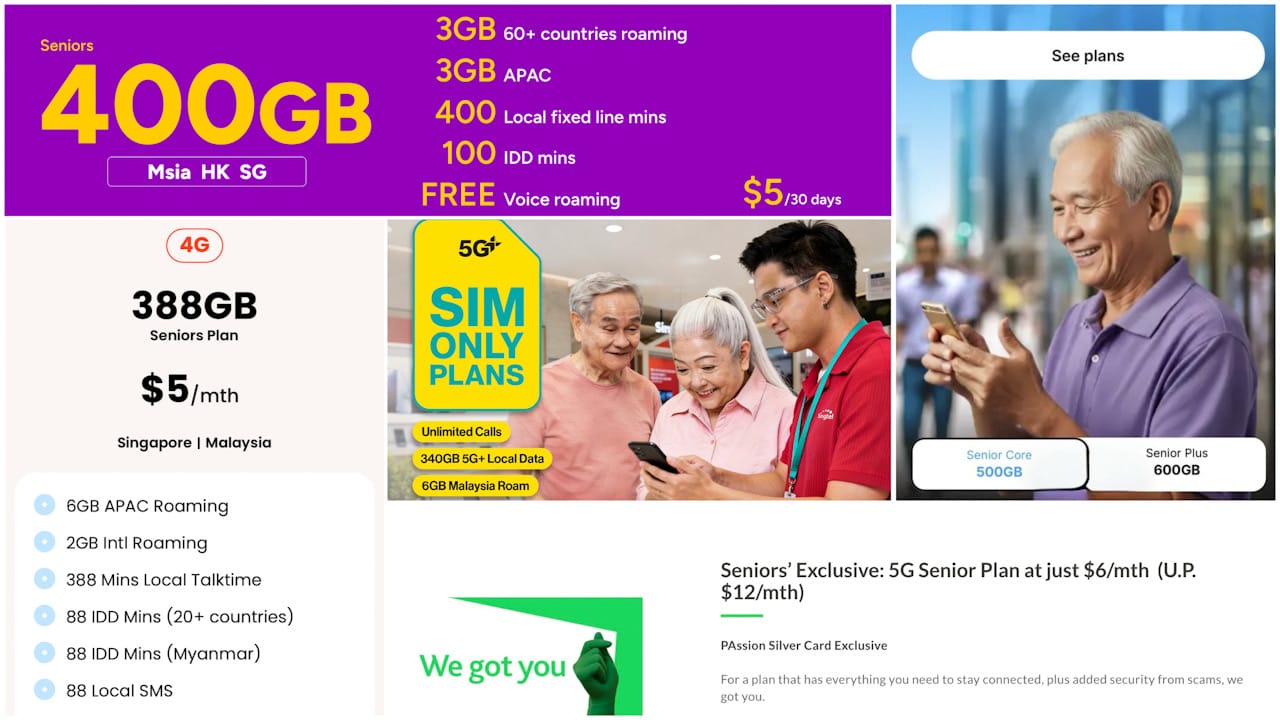
Singtel, Circles.Life, SIMBA, Eight, and StarHub all want a piece of the same audience — and right now, they’re not phoning it in (sorry).
We’re talking hundreds of gigabytes, roaming, bundled perks, all for about the price of a (Starbucks) kopi. But deciding which is best is less straightforward unless you dig into it — which is what we did.
Because once you get past the big-font numbers, these plans aren’t really competing head-on; they’re solving slightly different problems. If you pick the wrong one, you probably won’t notice until it’s too late — usually somewhere between JB customs and “BOY AH WHY MY PHONE CANNOT CALL AH?”
Before we get into it, one quick note: these are not the IMDA Mobile Access for Seniors plans, which are the baseline options. What we’re looking at here are the souped-up, full-fat versions — more data, more features, and just enough complexity to make you second-guess what you really want.
But not to worry, we’ll simplify them so you’ll know what you need. Whether you’re choosing one for yourself or for your parents, the goal is the same: pick something that just works.
The tale of the tape
| Singtel | Circles.Life | SIMBA | eight | StarHub OnePA | |
|---|---|---|---|---|---|
| Plan | Seniors SIM Only | Senior Core | Plus | Seniors Go Digital | Senior Mobile Plan | 5G Senior Plan |
| Price | SGD 6/mth | SGD 5/mth | SGD 8/mth | SGD 5/mth | SGD 5/mth | SGD 6/mth (until 31st Dec 2026) |
| Network* | 5G+ (SA) | 4G | 5G (SA) | 5G (NSA) | 4G | 5G (SA) |
| Local Data | 340GB 5G+ (40GB + 300GB promotional) | 500GB | 600GB | 400GB (shared between Singapore, Hong Kong and Malaysia) | 388GB (shared between Singapore and Malaysia) | 150GB |
| Talktime | TalkMore Unlimited (Fair use cap of 10,000 min monthly) | Unlimited | Unlimited to local numbers, 400 min to landline numbers | 388 local min | 500 local min |
| Local SMS | 500 | 25 | 100 | 88 | 500 |
| Bundled roaming SMS | — | — | — | — | Unlimited across 165 destinations |
| MY Roaming | 6GB/mth | — | Shared with 400GB local data | Shared with 388GB local data | Shared with 1GB regional data |
| Regional Roaming | — | — | 1GB (7 countries) | 3GB | 6GB (6 APAC countries) | 1GB (5 SEA countries) |
| Worldwide Roaming | — | — | 3GB (60+ countries) | 2GB (57 countries) | 1GB (165 countries) |
| IDD Minutes | — | — | 100 mins (20+ countries) | 88 mins (20+ countries) plus 88 mins for Myanmar | — |
| Voice Roaming | — | — | VoLTE, FREE | VoLTE, 288 min incoming, 288 min outgoing to Singapore, 288 min to local country | Unlimited calls across 165 destinations |
| Incoming SMS, Incoming calls, Caller ID | Free | Free | Free | Free | Free |
| Other features | Scam Call Protect | Zerofy | Zerofy + CirclesAI | — | — | ScamSafe |
| Contract | 12 months | 30-day billing | 30-day billing | 30-day billing | 30-day billing |
| Eligibility | Seniors (60+) | Seniors (60+) | Seniors (60+) | Seniors (60+) | Seniors (60+) and PAssion Silver Card |
* Network classifications (e.g. 4G, 5G, SA, NSA) are based on provider disclosures and may vary by device, location, and ongoing network upgrades. It is also not a direct indicator of real-world performance.
Data No Enough 2026: Spoiler alert, it’s a non-issue
Let’s get this out of the way — 340GB; 400GB; 500GB, they’re functionally the same. The only outlier is the OnePA-StarHub offering, which is notably less at 150GB.
However, unless you have a penchant for watching Netflix on train rides without pre-downloading videos, you’re unlikely to exceed those limits. For most seniors, data will likely be spent on WhatsApp sharing, the occasional YouTube video, and maybe Facebook or TikTok ‘doomscrolling’ if they’re feeling adventurous.
While the numbers are impressive, they’re relatively low on the priority list and shouldn’t lead the decision. Similarly, we don’t put as much emphasis on 4G vs 5G for day-to-day use, as there are many factors like coverage area and device compatibility that make the conversation complicated, and the performance gains may not be ‘night and day’ either.
If faster speeds are more of a concern — on paper, at least — then StarHub’s OnePA plan and Singtel’s Seniors SIM Only plan take the lead here with their true 5G plans (5G Standalone, or SA), and with Singtel claiming 5G+ enhanced speeds and network prioritisation. Circles.Life offers this too, but as a paid upgrade (Senior Plus plan).
Realistically, it’s less about needing the speed and more about the assurance it brings — the kind that comes with getting your parents ‘the best’, so they can feel good about it while telling you, “aiyoh, you shouldn’t have lah!”
If it’s mostly local, keep it simple
For everyday use in Singapore, Singtel is the easiest to recommend, especially for those with traditional phone habits — that is, a heavy reliance on calls and SMS.
What you get with Singtel’s Seniors SIM Only is generous call and SMS allowances. Calls are virtually unlimited thanks to a fair-use cap of 10,000 minutes, which amounts to over 5 hours a day. The structure is simple enough — 500 messages, 340GB of local data and 6GB of data for the occasional foray to Malaysia. It also includes free Scam Call Protect to screen out known scam call numbers, adding another layer of reassurance.
Also, if things go wrong, there are roughly over 50 retail stores islandwide that seniors can approach for physical help — no chatbot, no squinting through pages of FAQ, just a human being for the “I got you fam” aka “I help you settle” vibes.
It definitely isn’t the ‘cheapest’, in that it costs a dollar more and requires you to contract for a year, but that is hardly a deal-breaker. But if you want the most complete plan for the basics, it’s tough to do any better.
JB changes the equation — but not as much as you’d think
If Malaysia is part of the routine, both SIMBA and Eight solve the same core problem in the same manner: you don’t have to think about it.
That means not having to switch plans or buy add-ons, which translates to no last-minute panic at the checkpoint. They do this by effectively treating Singapore and Malaysia usage as a single pool, with Malaysia considered ‘local’ data.
Both plans are broadly similar in what they offer — right down to roaming perks. What they differ can be summed up as such. If you travel more often in Asia, go with Eight (do check their country coverage for confirmation) over SIMBA, which divides coverage equally between worldwide and regional buckets. The only exception is if you visit Hong Kong regularly, as SIMBA counts it as part of its shared local data pool.
However, there’s one slight twist in this tale — SIMBA offers unlimited calls to local mobile phones on top of the 400 minutes to local fixed lines, which gives it an edge for everyday calling.
These distinctions aside, they’re going to feel very similar in day-to-day use for most people, unless you have exceptionally heavy call needs.
Going further? Decide what you’re afraid of
For seniors who travel their fair share, you have two clear options. StarHub’s OnePA collaboration plan, or Eight/SIMBA, depending on the criteria we just discussed.
StarHub’s OnePA plan takes a very specific angle: communication over everything else. You get unlimited roaming calls and SMS across a wide range of destinations. It’s the more reassuring option for those who value being able to call anyone at any time.
The trade-off here is data: 1GB for regional (including Malaysia) and 1GB for worldwide will get you maps, messages, and maybe a quick search. That’s about it. If you’re expecting to scroll Instagram in Tokyo, you’re going to have a bad time.
So, if they’re more likely to doomscroll than to call up people to ‘roast’ them affectionately on their lifestyle choices, then SIMBA and Eight’s approach is a little safer.
Old school vs new school: customer support edition
Some decisions can be complicated and nuanced, but this isn’t one of them.
As alluded to earlier, some seniors may struggle with troubleshooting their phones and mobile phone settings.
If the user wants the option to walk into a shop and sort things out face-to-face, Singtel is the obvious choice. StarHub, to a lesser extent, can also support in this way. The others lack the physical retail presence.
On top of that, both Singtel and StarHub offer scam protection as an added guardrail. Singtel has built-in network-level blocking via Scam Call Protect, and StarHub through its ScamSafe app tools, helping to screen out suspicious calls and messages.
If peace of mind is what you value, go with either of them. Although the solutions seem relatively trivial, they cover two common ‘it’s fine — until it isn’t’ situations.
A rather niche requirement — IDD
While we live in an age when apps like WhatsApp and Telegram have made international direct dialling (IDD) unnecessary, there might still be some people who are locked into landlines or disconnected from technology elsewhere in the world.
In such increasingly rare instances, a provision for IDD might be good to have. In this case, the options are simple: only Eight and SIMBA provide this. If you need to call Myanmar, Eight is the automatic choice.
Circles.Life: the wildcard choice for savvy seniors
You’d have noticed by now that we’ve not mentioned Circles.Life much — that’s because it doesn’t quite play the same game.
Seniors Core is a relatively simple 4G plan that’s extraordinarily focused. You give up any semblance of roaming — 1GB regional-only — and SMS (only 25) for unlimited calls and a generous 500GB data cap. If you want 5G (SA) and another 100GB of data (600GB data cap), pay SGD 8 for the Seniors Plus plan.
What’s interesting is the bundle. Zerofy is a low-commitment rewards programme that is good for regular shoppers on Shopee, Lazada and Foodpanda, and you can offset the SGD 5 bill with it.
But the standout is that these two plans include CirclesAI, which gives you access to paid versions of OpenAI GPT, Google Gemini, Perplexity Sonar, Claude, Deepseek, and Qwen. The trade-off is that these are not full-fat versions, i.e. you access them via CirclesAI, but it’s a great value nonetheless for adventurous seniors who want to explore the AI trend.
The long-term trap
While it’s tempting to want a great plan that you sign once and then live happily ever after, it doesn’t work that way in Singapore. For the time being (and for the longest time), we have some of the most aggressive telco and MVNO price wars in the world, which is great for buyers.
In theory, no contract plans mean that providers can make unfavourable terms next month after you are on board, but market pressures make that scenario highly unlikely. It’s far too easy to retain your number and switch providers in minutes.
Short one-year contracts are the most you’d want to commit to. This is why Singtel’s contract requirement isn’t a downside, since mobile plans these days — as a good habit — should be reviewed at least annually.
After a year, it’s far better to keep a lookout for the latest deals to get more data, minutes, or other perks, for a fraction of the price you paid previously. Cheap thrill, but a thrill nonetheless.
So, what should I choose?
There’s no clear winner here as each plan is built around a different set of priorities. Because of the low price, trade-offs are inevitable as everyone tries to find their lane. So instead of a ‘just buy this and forget the rest’ answer, here’s how they break down based on what matters most:
- Unrestricted use in mostly local settings → Singtel
- Frequent JB trips → SIMBA or Eight
- Travels further, with ease of contactability via calls → StarHub
- Travels further, wants usable roaming data instead → SIMBA or Eight
- Need actual staff to physically help → Singtel or StarHub
- More digitally comfortable and adventurous →Life
- If you must call someone overseas who doesn’t use WhatsApp or Telegram → SIMBA or Eight
In short, they’re all good for specific purposes, and picking the best fit is far more important.
Information is correct as of 10 April 2026. Plans and details may change — refer to official sources for the latest information.
*Update: Singtel PAssion Silver Concession Card requirement removed from table. Singtel has clarified that PAssion Silver Concession Card is used only as a document to verify seniors’ age, and is not a requirement; other age-verification documents should be acceptable.