
Before you can make sense of a thesis, you first have to make sense of the research.
Students already know this; finding an answer online is easy. Finding academically useful material that is credible and specific enough to answer your question — especially when it is Singapore- or Southeast Asia-centric — is another matter.
The time sink doesn’t stop at reading; It includes iteratively refining your searches, studying prospective papers and working out which sources are worth pursuing and which lead nowhere. AI tools like Gemini Notebook can help researchers skim and summarise documents — but you still need to find the materials first.
That’s where NUS Libraries’ AI Sense Maker comes in. No, it doesn’t magically research for you, but it can drastically reduce the number of steps needed in that time-consuming process — pruning searches, reducing time spent on weak leads, and helping users find the most relevant material sooner.
Here’s how it works: a user poses a question in conversational language and chooses between fast, reiterated, or deeper searches. AI Sense Maker responds with a structured overview and a map of related concepts, all with references drawn from 150,000 digitised materials. NUS says this can cut the initial research-discovery process from about two weeks to 30 minutes or less.
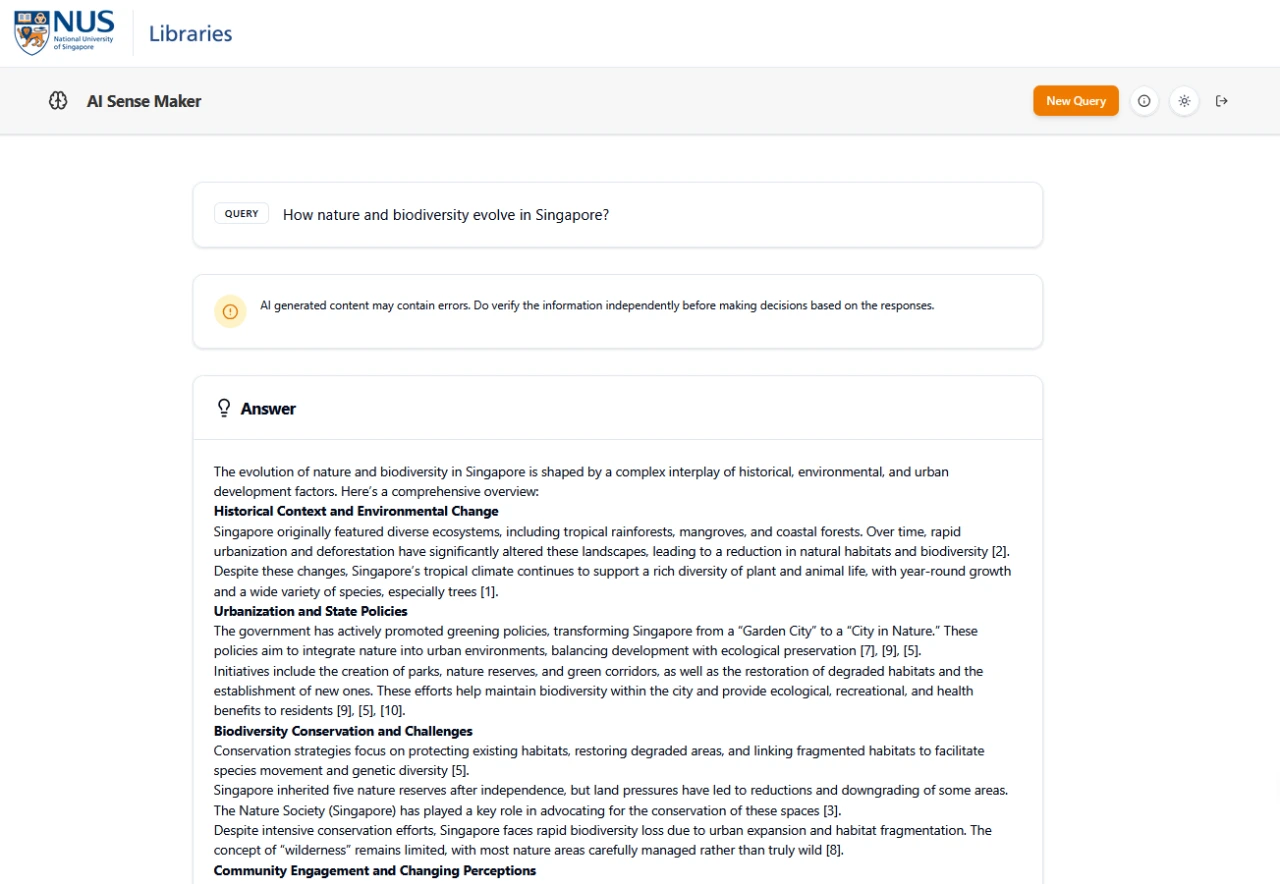
AI Sense Maker generates a summary, complete with references from NUS’ digitised sources.
How AI Sense Maker searches NUS’ collections
Students and faculty researchers need not wait too long to try it out for themselves, as AI Sense Maker will launch on 20 August 2026. The platform, which uses OpenAI’s large language model, was developed in-house by NUS Libraries and NUS Information Technology over 12 months.
AI Sense Maker’s initial collection materials come from ScholarBank, NUS’ repository of research papers and other scholarly outputs, and Digital Gems, a digitised collection of rare and special materials focused on Singapore and Southeast Asia. The oldest digitised books date back to the 17th century, although the platform only covers material that has been digitised and incorporated into these repositories.
Like regular language models such as ChatGPT, Gemini, and Claude, AI Sense Maker not only matches the words entered but also interprets the meaning behind the question. As such, it can surface papers that use terminology the user has not yet learnt or mentioned, use the retrieved material to build a summary, identify related concepts and suggest further reading.
Because summaries can strip away nuance, all responses are displayed with references — every fact must be attributable to one — allowing users to trace the answer back to its sources.
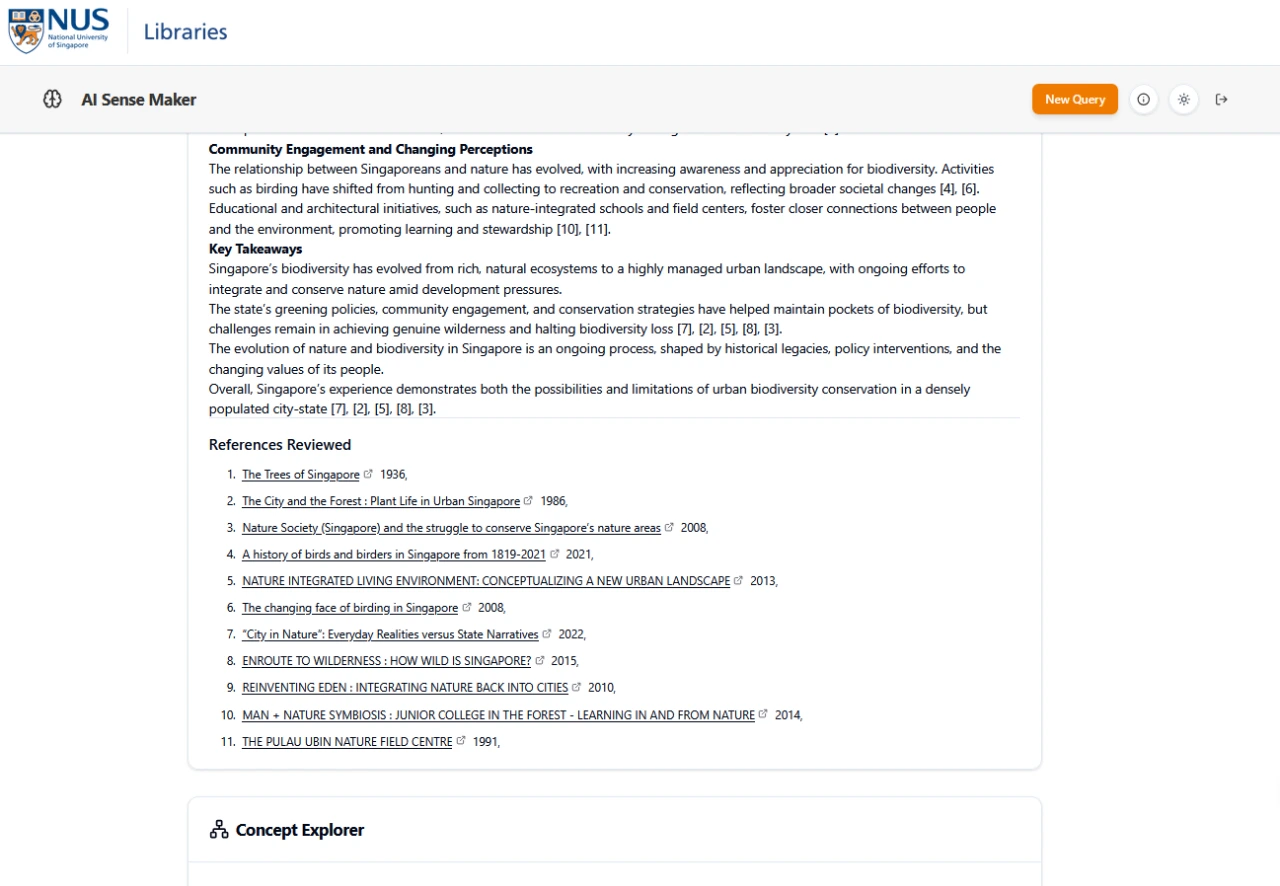
Every fact listed in AI Sense Maker is attributable to a digitised source.
The summary explains; the graph maps
AI Sense Maker has another trick up its sleeve: an interactive knowledge graph that reveals adjacent ideas and relationships that would be harder to spot in a flat results page or a conventional linear explanation.
As the graph can show several relationships at once, it’s particularly useful when the subject crosses disciplines or when the researcher doesn’t yet know what to search for.
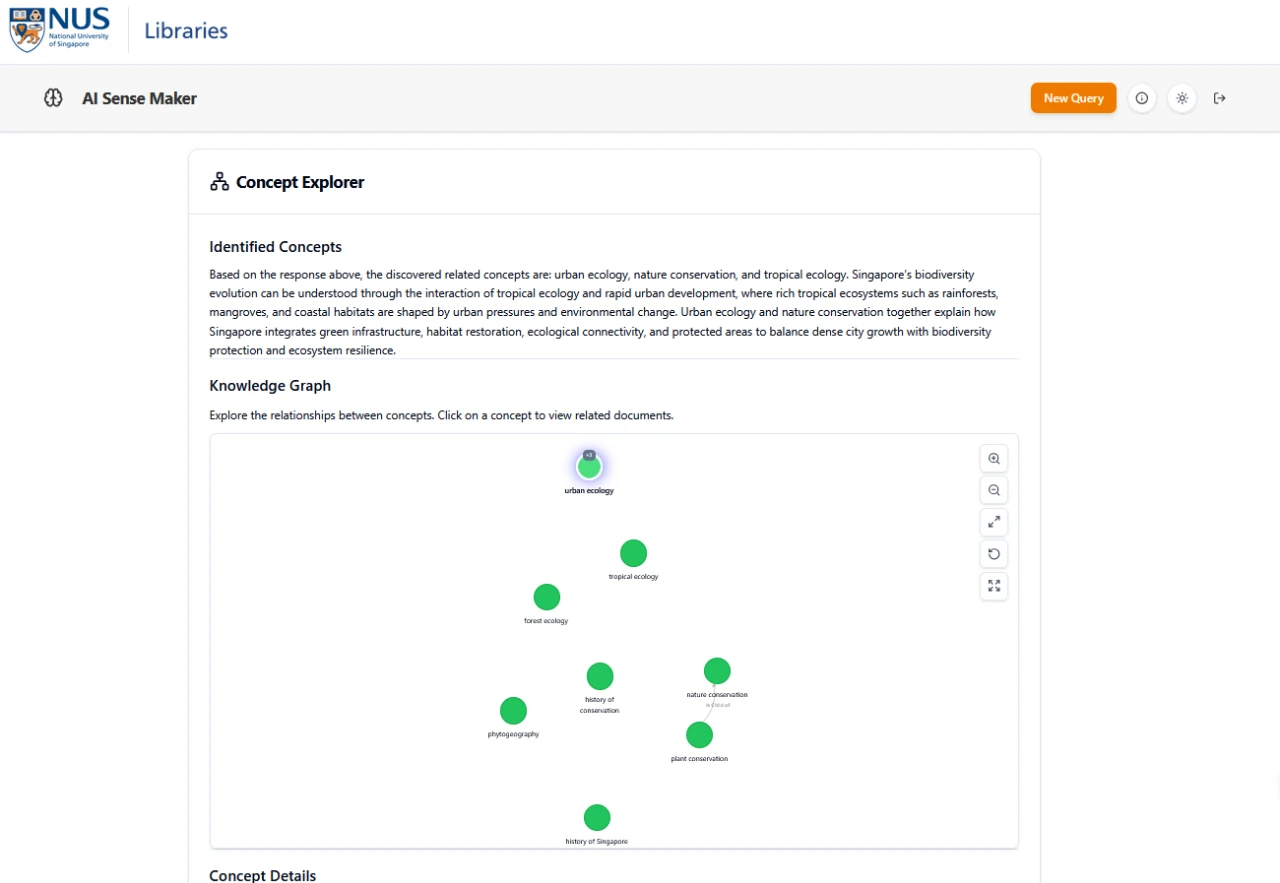
Concept Explorer uses a Knowledge Graph to help users understand the relationships between central ideas.
For example, if you pose a question about Singapore’s biodiversity, the platform pulls concepts such as urban ecology, nature conservation and tropical ecology. Clicking one of these concepts produces an explanation and a list of related documents, elevating discovery into structured learning.
The graph is the visible layer on top of a managed taxonomy, a hierarchy that defines how subjects are classified and related. This tells the system that botany sits under biology while linking it to neighbouring fields such as plant physiology, agronomy, and ethnobotany.
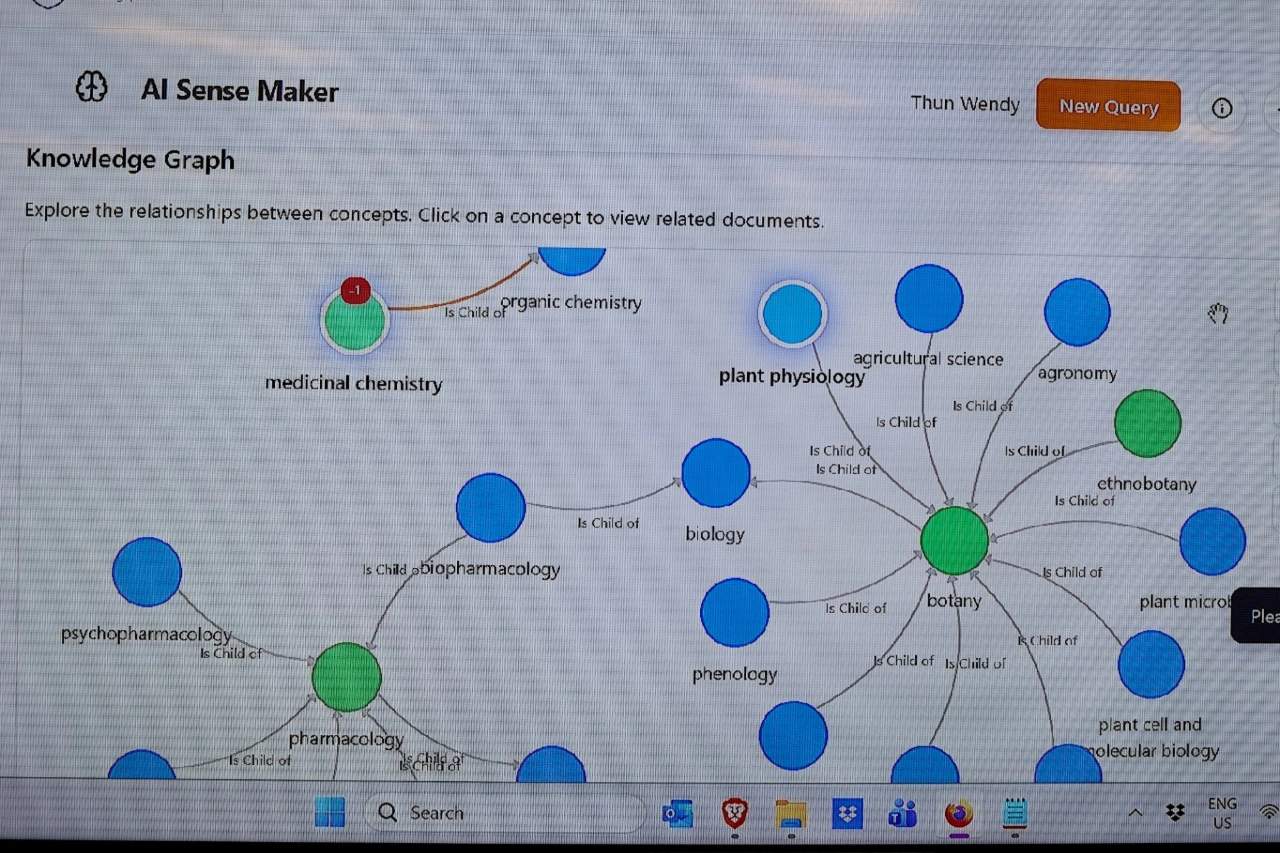
The Knowledge Graph can show hierarchical relationships and kickstart related exploratory searches.
NUS said it uses Wikidata as a starting point, then scopes and refines those relationships around its collections and academic needs. Creating and maintaining that structure is laborious, but it gives the language model clearer boundaries and helps keep its responses consistent across queries.
A faster start, not finished research
AI Sense Maker cannot assess every argument or make a final case for its user; nor is it in the institution’s interests to do so.
Its practical value lies in addressing a process that, if done in earnest, could take days or weeks.
Now, a few enquiries and quick reads can give you a grounded starting point to work from in a fraction of the time — and more importantly, help you make sense of it all.