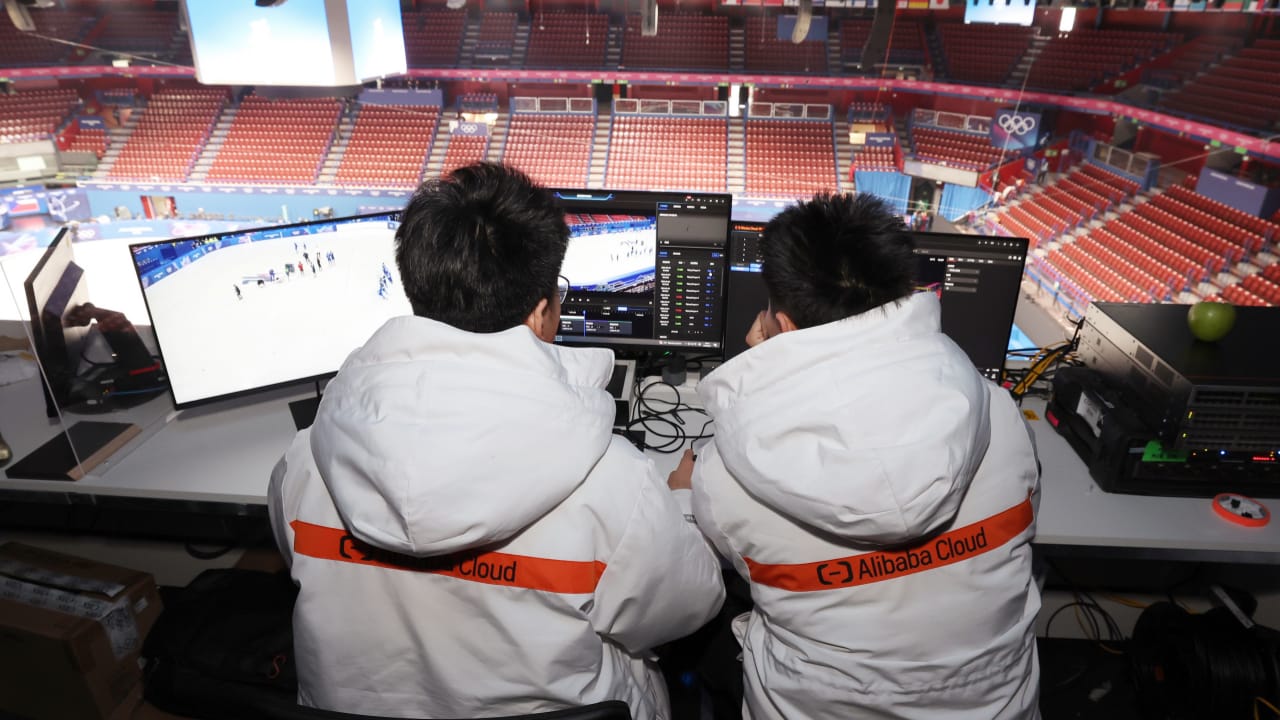
If you notice only one thing different at the Milano Cortina 2026 Winter Olympics, it may well be the replays. Instead of yet another slow-motion angle repeated from the same camera, you may encounter a new visual format: Spacetime Slices, part of the upgraded Real-Time 360º Replay system that Alibaba Cloud says will be deployed across 17 sports and disciplines.
Think The Matrix’s iconic bullet-time, but evolved for sport. While bullet time freezes a single moment and spins the camera dramatically around it, Real-Time 360º Replay does something more ambitious: reconstructs key moments of the athlete’s movement in 3D, allowing the virtual camera to orbit any point in the motion rather than just a single frame, closer to scrutinising a character model in a video game from any angle than watching a conventional replay.
Instead of viewing only a single frame, Spacetime Slices layers several key positions from a movement into a single composite image, effectively translating a quick, highly technical athletic motion into something the eye can understand instantly. Whether it’s a ski jump or a figure-skating spin, viewers can study these technical motions with an almost anatomical view from the comfort of their own home.
The Winter Games are particularly well-suited to tech like this. Many of its disciplines involve high-speed motion against visually complex snow and ice backgrounds, which are challenging for traditional broadcast techniques. AI separates the athlete from the snow or ice and combines footage from multiple cameras to build a full 3D view of the movement in roughly 15 to 20 seconds, fast enough for live commentary rather than a post-event novelty.
Why this is possible now
This is one of several broadcast techniques available at Milano Cortina 2026, which Alibaba and OBS position as a step-change towards cloud-based, AI-enabled broadcasting rather than an experimental add-on. Olympics Broadcasting Services (OBS) and Alibaba Cloud provide the capability; rights-holding broadcasters decide how deeply to integrate it, if at all.
That shift is the result of a long-running partnership between Alibaba Cloud, OBS, and the International Olympic Committee (IOC): Tokyo 2020 familiarised broadcasters with cloud-based distribution; Beijing 2022 introduced BulletTime; Paris 2024 laid early groundwork for Sports AI, bringing us to Milano Cortina, which features the most integrated version of this AI-centric framework yet, spanning replay generation, media tagging, archive search, and broadcast delivery.
AI’s role in background infrastructure
While the most eye-catching features may or may not fit every broadcaster’s editorial style, the off-camera infrastructure addresses universal needs, particularly for remote production.
OBS Live Cloud, running on Alibaba Cloud infrastructure, distributes live video and audio feeds without relying on dedicated satellite or physical links. Alibaba says OBS Live Cloud has evolved from an optional service into a core distribution platform, and was the primary method for remote broadcast delivery at Paris 2024. For the first time, broadcast rights holders can also receive HD streams via the OBS Olympic Video Player on the same cloud backend, reducing the need for on-site systems. Together, this makes centralised, scalable production far easier to manage.
On the editorial side, OBS says it is currently in the early development phase of the Automatic Media Description system, powered by Alibaba’s Qwen large language model, designed to identify athletes, tag key actions, and generate baseline descriptions within seconds, making footage more searchable and accelerating highlight production.
This is complemented by the IOC’s rapidly expanding archive, now exceeding eight petabytes of historical footage. It integrates deeper AI tagging and conversational search into the existing media asset platform, helping broadcasters quickly find appropriate contextual clips.
Outside the live broadcast, the IOC’s new AI assistant provides conversational, multilingual access to schedules, results, and event information. The chatbot won’t change how the Games feel, but it signals that AI is now embedded across the Olympic ecosystem rather than confined to isolated production tools.
What is clear from Milano Cortina 2026 is that Alibaba Cloud now sits at the core of the Olympic broadcast system, and AI is becoming the default expectation for how footage is captured, reconstructed, searched, and explained, even though adoption varies among broadcasters.
The impact may not be bullet-time iconic, but if these ‘matrix code’ changes make a ski jump, a spin, or a landing easier to understand through replays and close the information gap between expert analysis and casual viewing, that is ultimately what a proper AI-embedded experience looks like.